 Mercor
Best AI Visibility Tools: 10 Platforms Compared for 2026
Compare the best AI visibility tools for tracking brand mentions in ChatGPT, Gemini, and Perplexity, with pricing, limits, and selection criteria.
Dheeraj
Published on November 18, 2026
A category question your brand has ranked for in Google for years comes up in a planning meeting. Someone pastes it into ChatGPT. Three competitors get named, with short reasons a buyer could act on. Your company does not appear. The marketing lead rewrites the question, tries Perplexity, and still sees the same gap.
Rank tracking never flagged it. Rank trackers watch a results page. AI answers often settle the question before a click happens. In a Pew Research Center study of browsing data from 900 U.S. adults, 58% ran at least one Google search that produced an AI-generated summary during March 2025. Across about 68,879 searches, ordinary organic links were clicked on 8% of visits when an AI Overview appeared, compared with 15% when no summary appeared. People ended the session on 26% of pages with an AI summary, versus 16% with traditional results alone.
AI visibility here means something narrow and useful. On prompts you choose, does a monitored model name the brand, cite a real URL, and describe the offer without inventing facts? These platforms do not see every shopper chat. They rerun a fixed set, on the engines a plan includes, on a schedule you can repeat. The point of the best AI visibility tools is a stable baseline, not a census.
The list below is organized by the decision in front of the team. Standalone tracker, SEO suite add-on, tracker that also recommends content, or a site-readiness audit. Published prices and caps change. Confirm them before you subscribe.
Table of Contents
1. Synup
Local brands fail in a specific way. The model may know the category and still get the address, hours, or which store to send someone to wrong. A mention tracker will not fix a listing that drifted last month.
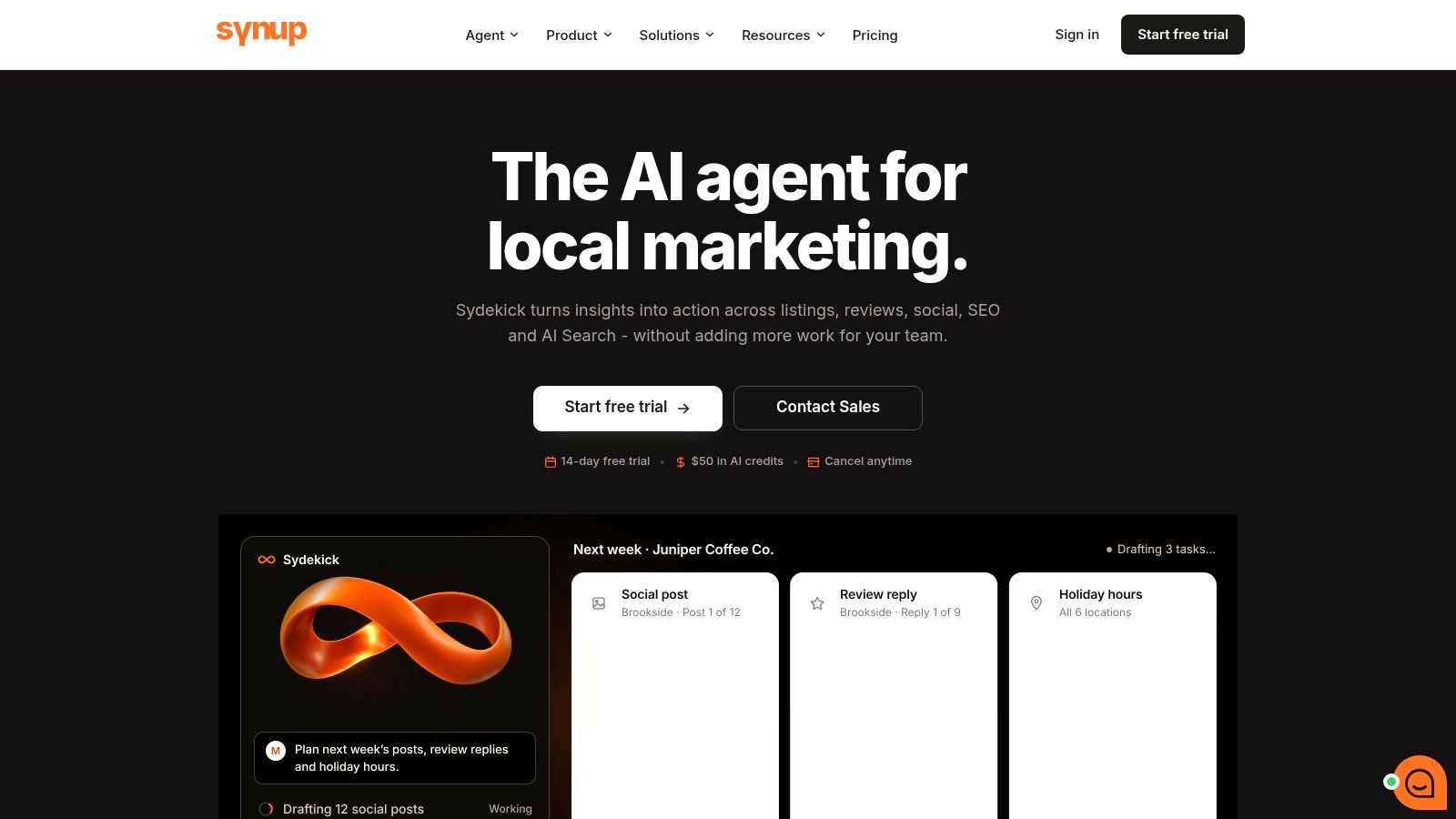
Synup's AI visibility tracking platform sits inside a local marketing system. Listings sync across Google Business Profile, Apple Business Connect, Bing, Facebook, and 100+ publishers, with ongoing audits and corrections. Review monitoring can draft replies and wait for approval before anything goes live. Review-request flows use short links. Social posts can be scheduled per location, with a voice stored for that store. A locator and per-location pages live on a custom domain and stay tied to the same records.
What the agent is allowed to do
Sydekick can research, draft, and publish, but only inside approvals and guardrails, with an audit trail of what it proposed and what it did. Answer engine optimization checks presence in ChatGPT, Gemini, and Perplexity and points at citation gaps. Agencies get a multi-client command center, a branded portal, white-labeling down to removing Synup's name, and scoped permissions. REST APIs, first-party MCP support, and bring-your-own-key or model options connect Claude, GPT, and Gemini to stacks you already pay for. Every plan includes the feature set. Tiers move with location count and agent throughput.
I would choose Synup when the miss is operational. Many locations, stale profiles, slow review replies, and no single place that owns the record. I would not choose it as a cheap prompt lab for one SaaS site. Three engines and local workflows will not replace a wide research index, and the sample is still the prompts you monitor.
2. Peec AI
Peec AI is the standalone I reach for when a small team wants AI-search reporting and nothing else on the invoice.
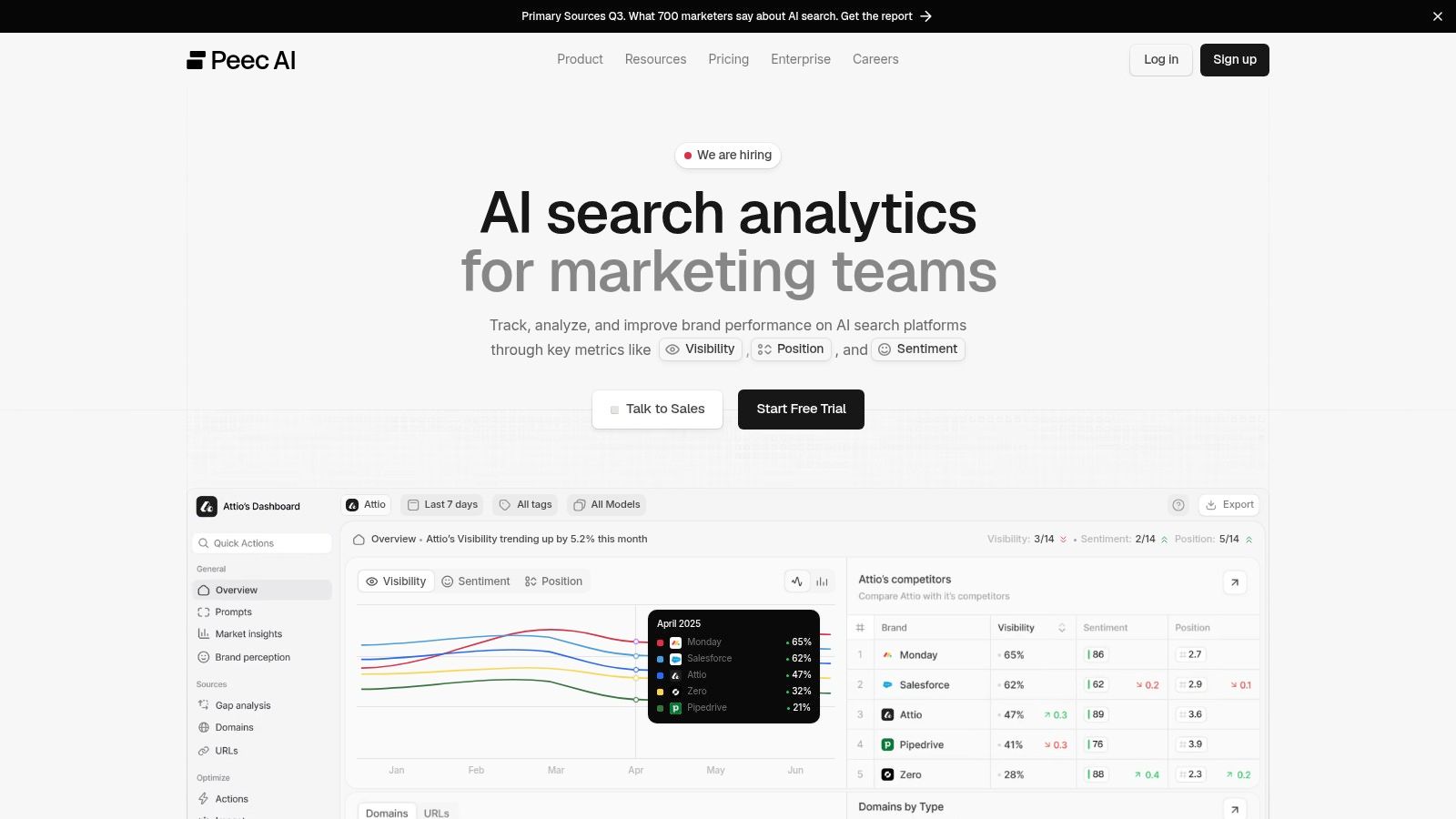
Public tiers are Starter, Pro, and Advanced, with Enterprise quoted. It tracks brand performance, competitors, prompts, and cited sources, on a daily cadence, with project tiers and unlimited users on the listed brand plans. Higher tiers add countries and a Looker Studio connection. That seat model suits an agency that shares one workspace instead of buying a login per person.
The limit shows up fast. Lower plans cap prompts, models, and projects. You can have a clean chart that only covers the questions you could afford to schedule. Enterprise coverage and deeper integrations sit on a higher or custom plan. None of this is every real user query.
Treat the prompt list like a panel you refuse to reshuffle every week, or the trend line is noise.
If the dashboard is empty because the brand is rarely named at all, the writing and source work in getting your brand mentioned by AI in 2026 belongs next to the tracker, not instead of it. Details live on Peec AI.
3. Otterly.AI
Otterly.AI is the accessible on-ramp, and the price is the reason I trial it before heavier platforms.
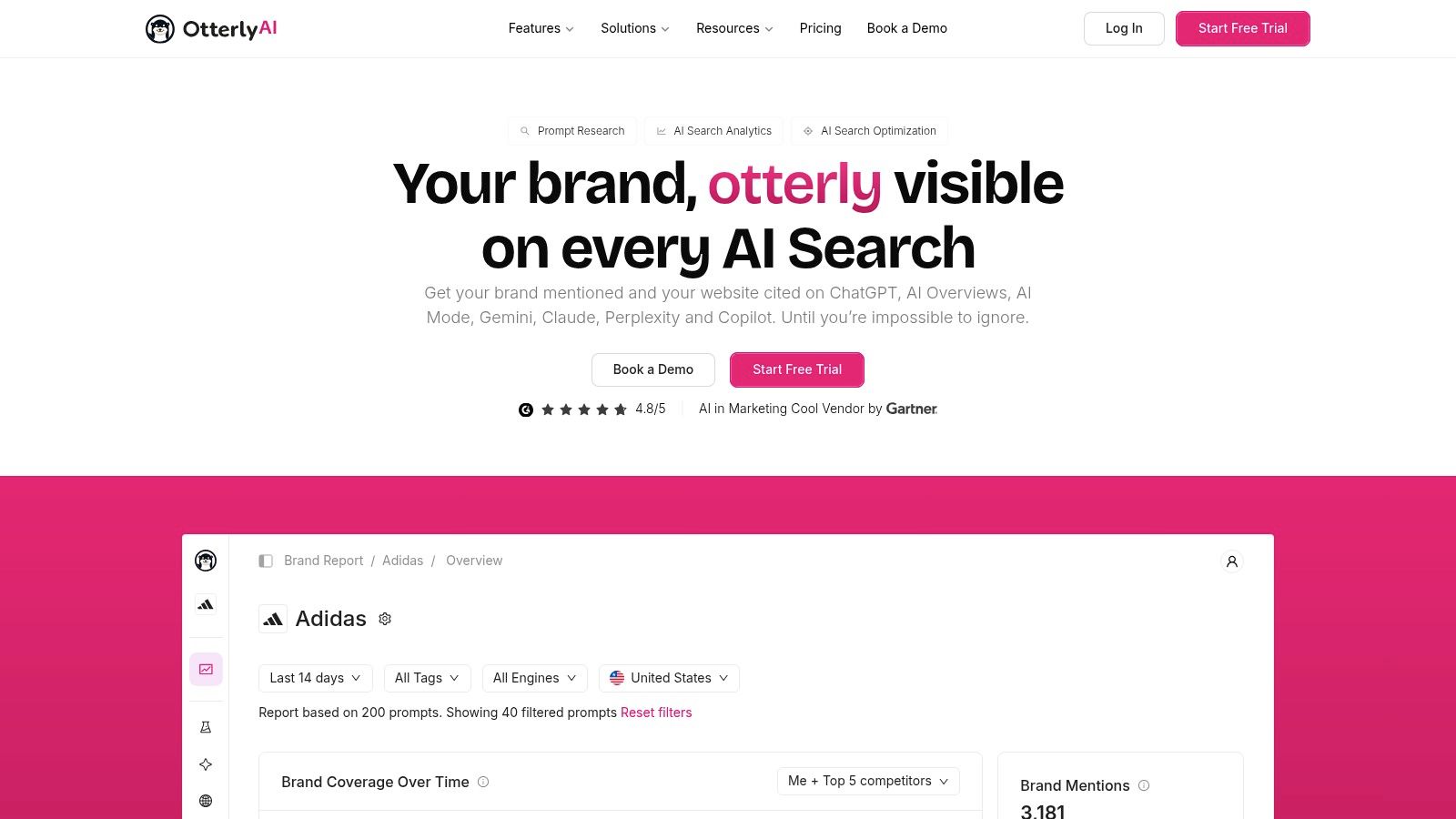
Published plans list Lite at $29 per month**, **Standard at $189, and Premium at $489, with custom Enterprise. You get visibility and citation tracking, brand profiling, competitor comparisons, optimization notes, and reporting. Eligible plans add API access and described workflows.
Engine coverage and prompt caps change by plan and add-on. Lite is a focused set, which is fine for one product line and a short list of buyer questions. Teams watching several brands, or refreshing a large prompt set often, outgrow it and land on a much larger bill. Recommendations are only as good as the prompts and the collection method.
I use Otterly when the question is “are we even in these answers?” and the budget cannot carry a suite. I do not use it as the system of record once country splits, many projects, and client-ready exports become the weekly job. Check current caps on Otterly.AI before you lock a tier.
4. Semrush AI Visibility Toolkit
For a team already reporting rankings in Semrush, the practical question is whether AI answers mention the brand and whether its pages are readable enough to be cited. The toolkit folds those checks into the same SEO workspace, making it the suite add-on option.
The AI Visibility Base plan is listed at $99 per month per domain when billed annually. Confirm whether the package you want requires a wider Semrush subscription before comparing the entry price with a standalone tracker.
The listed Base plan monitors mentions from ChatGPT, Google AI, Gemini, and Perplexity. It also includes prompt research, custom prompt tracking, competitor reports, and an AI-readiness site audit. Read those outputs separately. The tracker shows whether configured prompts surface the brand, while the audit shows whether weak page structure could be limiting citation. The results reflect the prompts being monitored, not every question a buyer asks.
Where the base plan runs out
Base lists 25 custom prompts and one domain for Brand Performance analysis. Those limits can cover a tightly scoped brand question, but they leave little room once tracking expands across products, markets, or prompt themes. Extra users, domains, and prompts raise the cost quickly. A team that only needs monitoring pays for a broader marketing platform. A team already using Semrush benefits from the overlap.
Keep the reported result tied to business output. Pair any “we showed up” claim with sessions and conversions from the same period, because a citation that never becomes a session is still just a sentence.
5. Ahrefs Brand Radar
Ahrefs Brand Radar makes sense when the SEO team already trusts Ahrefs and refuses another login.
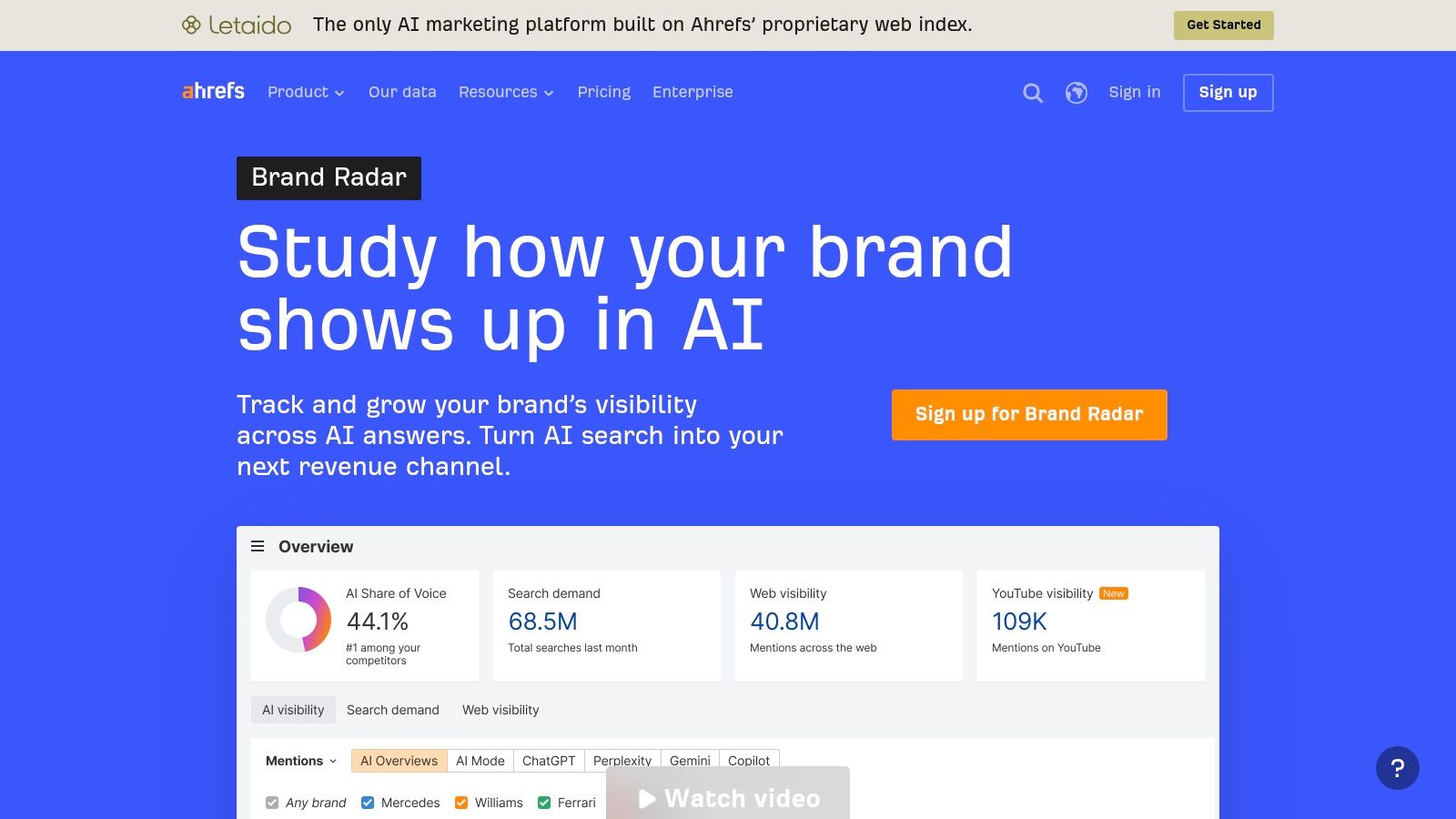
Brand Radar AI starts at $199 per month.** Custom prompt packages are listed at **$50 per month for 2,500 checks. Confirm whether the plan or add-on needs a separate Ahrefs subscription. You can research a large prompt database, track custom prompts on supported platforms, and set that next to keyword and backlink work you already run.
The metering is the part people miss in a demo. Custom tracking is counted by prompt, platform, and location. A modest weekly set across four engines and two countries spends the package faster than a single-engine test. Broad database research is useful for finding topics to investigate. It is not the same as proof that your buyers asked those questions yesterday.
I would not buy this as a first monitor for a small business that only needs a dozen prompts. I would buy it when Ahrefs is already the research desk and Brand Radar is an add-on, not a second strategy. See Ahrefs Brand Radar.
6. Profound
Profound is the monitor that also wants to help you publish. That second job is why the price jumps.
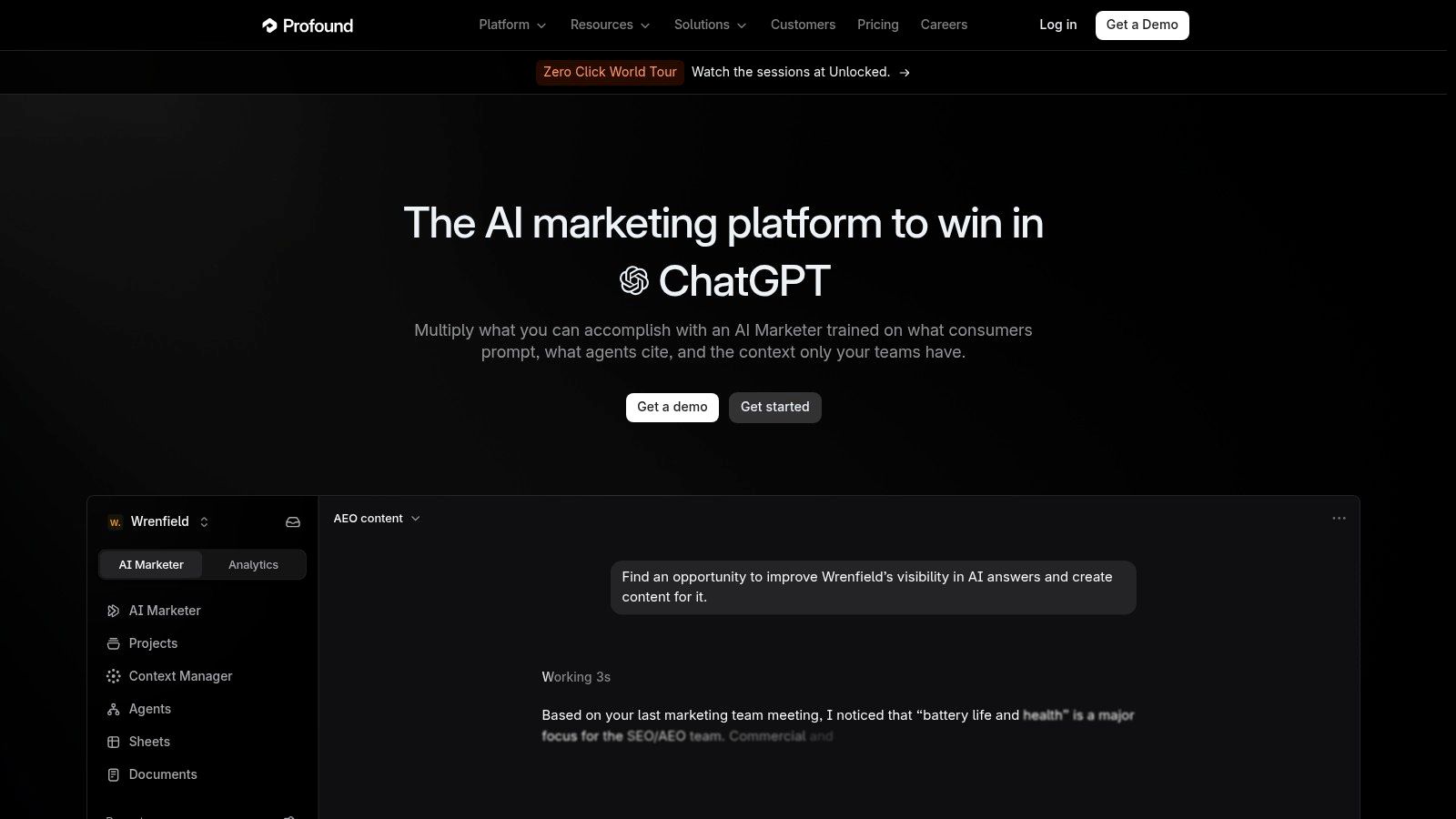
Starter is listed at $99 per month billed yearly** and tracks ChatGPT only. **Growth is $399 per month billed yearly. Enterprise is custom, with broader engine coverage and support for multiple companies. You get competitor views, prompt tracking, and response analysis. AI-oriented content tools show up on the higher plans.
Starter is a ChatGPT sample. If buyers also ask Gemini or Perplexity, that plan will flatter you.
Public entry pricing lets a team see the bill before a sales call, which I prefer to a demo-only quote. The trade-off sits at Growth. It costs far more than a light tracker, and the jump only pays off if the content layer gets used. Buy Growth for monitoring alone and you are funding features that sit idle. Enterprise coverage is a conversation, not a checkout box, so confirm which engines are included before signing.
Starter works when ChatGPT is the channel that matters, with a move up once the prompt set is stable. Current packaging is on Profound.
7. Scrunch
Scrunch is the site-readiness bet. Measurement is paired with an audit of whether an agent can use the site.
Core is listed at $250 per month and includes a seven-day trial. Enterprise is custom. Core tracks brand presence across topics, audiences, and markets, and audits technical and content factors tied to AI visibility. It also lists multiple workspaces and user licenses, which is more than a single-seat toy. Agent Experience Platform features, and a wider model set than Core, sit on Enterprise.
Core's prompt and model coverage is limited. At this price, a small business is making a real commitment for a partial map. I recommend Scrunch for a mid-market team that already knows it is mentioned sometimes and suspects the site is the bottleneck, blocked pages, thin entity information, or content an agent cannot lift cleanly. I do not recommend it as a first $29 experiment. If you need the wider model list, budget for the custom tier and ask which engines are in the contract. Start at Scrunch.
8. AthenaHQ
AthenaHQ mixes tracking with recommendations, and it meters the work in credits, which forces a usage plan.
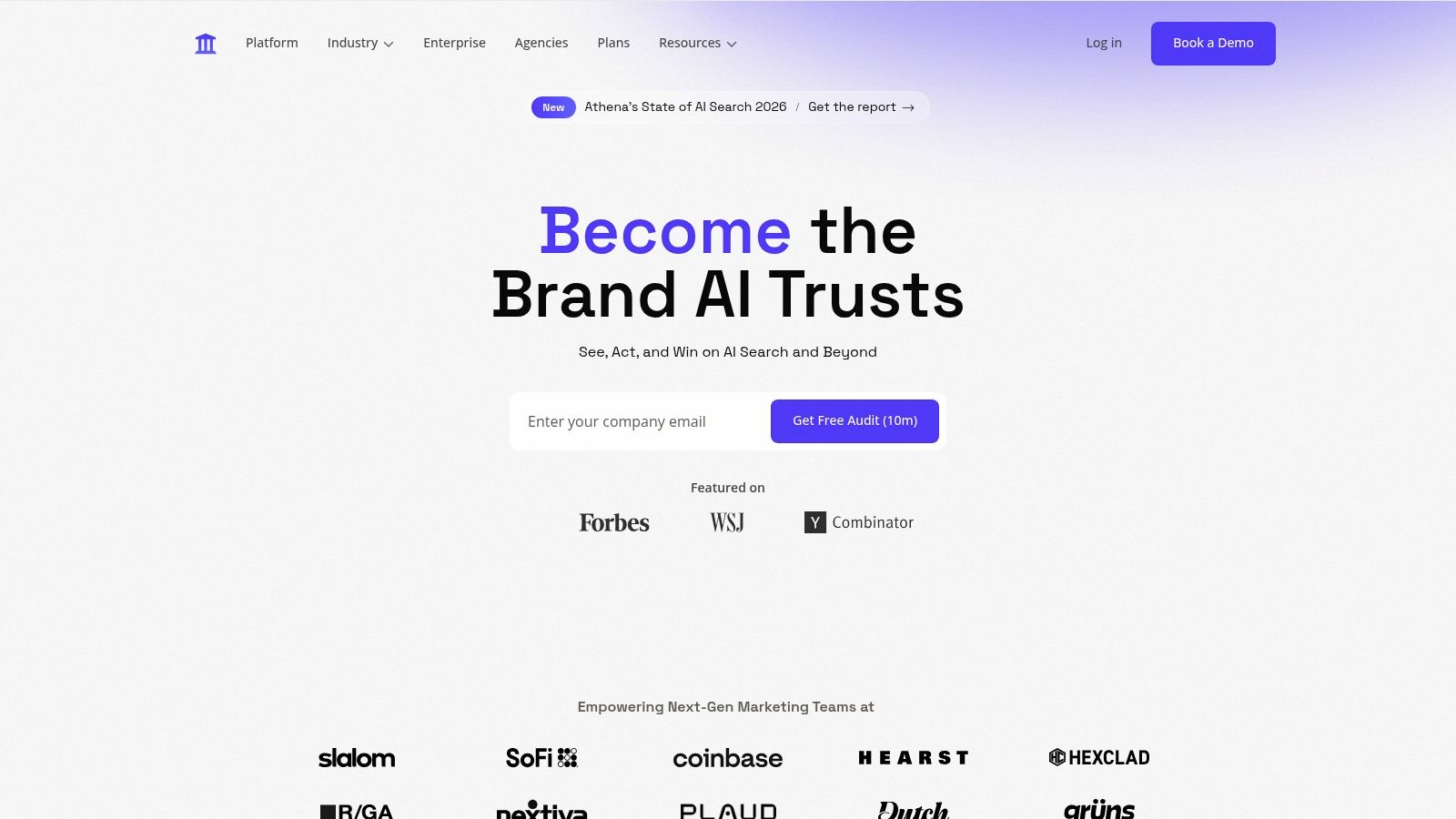
Essential is listed as free with 300 credits. Starter is listed at $295 per month with 3,600 credits. Check what a credit buys on each plan before you compare it with a flat prompt cap. Tracking covers ChatGPT, Perplexity, Google AI Overviews, Gemini, and other platforms, plus prompt and response analysis, sources, and competitors. There is an AI agent feature and listed connections to Google Analytics and Google Search Console.
The free tier suits a first look at the interface, while a serious baseline needs a paid plan. Starter is expensive for a very small team, and credits make two workloads hard to compare until you know how each engine and refresh rate spends them. The analytics hookup is the main draw: a mention and a session can sit closer together. Treat the agent's suggestions as drafts. Export each recommendation and check it against the live page before anyone publishes, because the model's "fix" is often a page you should not rewrite. Plans are on AthenaHQ.
9. Rankscale
Rankscale wins on engine count, and you pay for that breadth in credits.
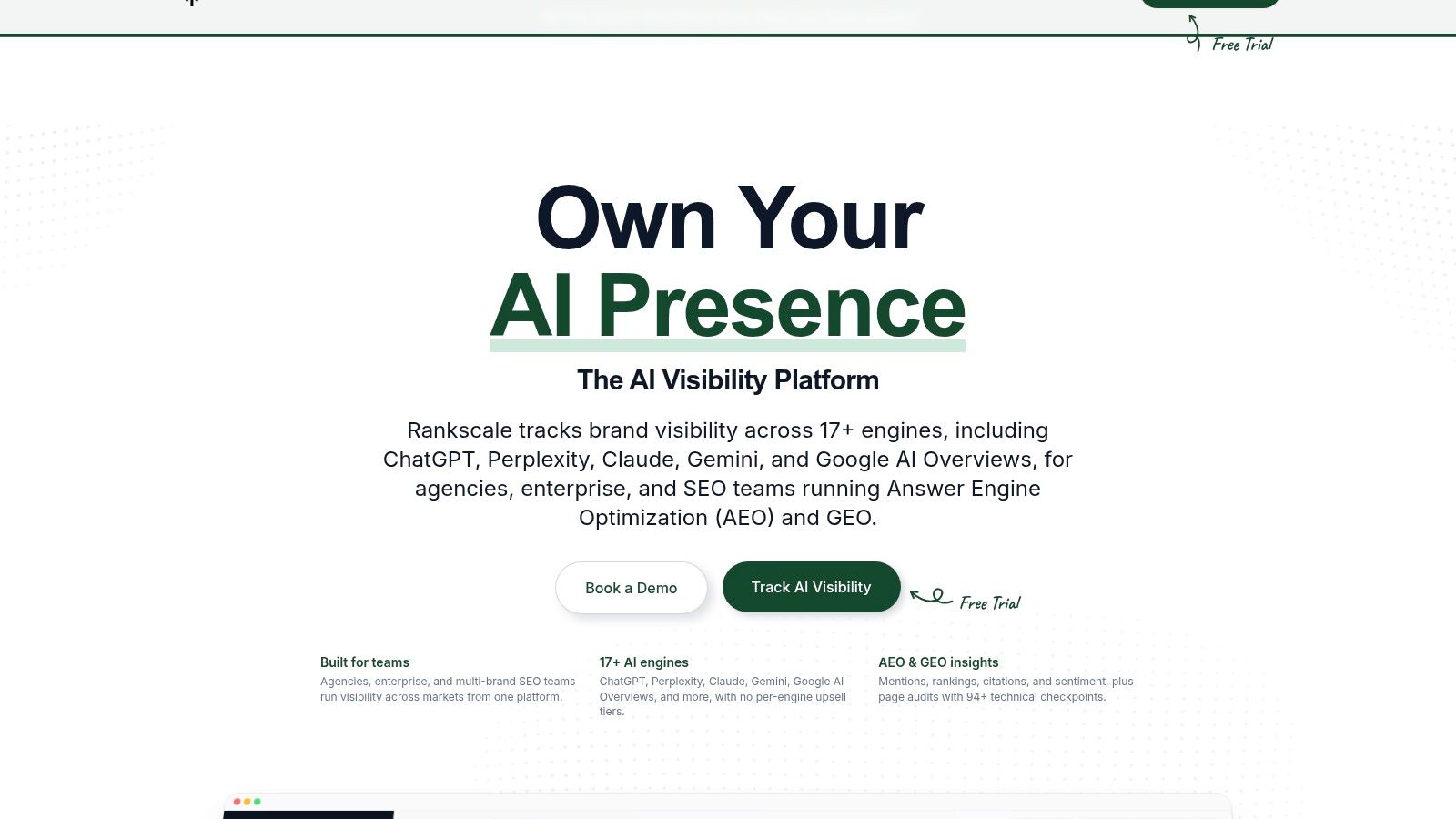
Its pricing page says it monitors more than 17 AI engines. Published plans list Pro at $99 per month**, Pro+ at $229, Growth at $385, and **Enterprise at $780, with annual billing discounted and an Essentials option for limited use. You can track visibility, mentions, citations, sentiment, and competitors. Page audits and prompt research land on different tiers. Scheduling runs from hourly to monthly, with dashboards and MCP. REST API access is on higher plans. Eligible plans include agency extras such as white-label.
- Credit math: Engines do not cost the same credit. A wide fan-out on a short prompt list can outspend a deep list on two engines.
- Cadence: Hourly checks burn the allowance. Monthly checks hide swings that a sales cycle would have cared about.
- API gate: If reporting has to leave the tool, confirm the tier before you promise a client export.
I pick Rankscale when buyers are scattered across many assistants and a four-engine tool would leave a hole. I skip it when the team will not learn the credit table. See Rankscale.
10. Writesonic GEO
Writesonic is the content suite that added GEO tracking. Buy it when the same people who find the gap also have to draft the page.
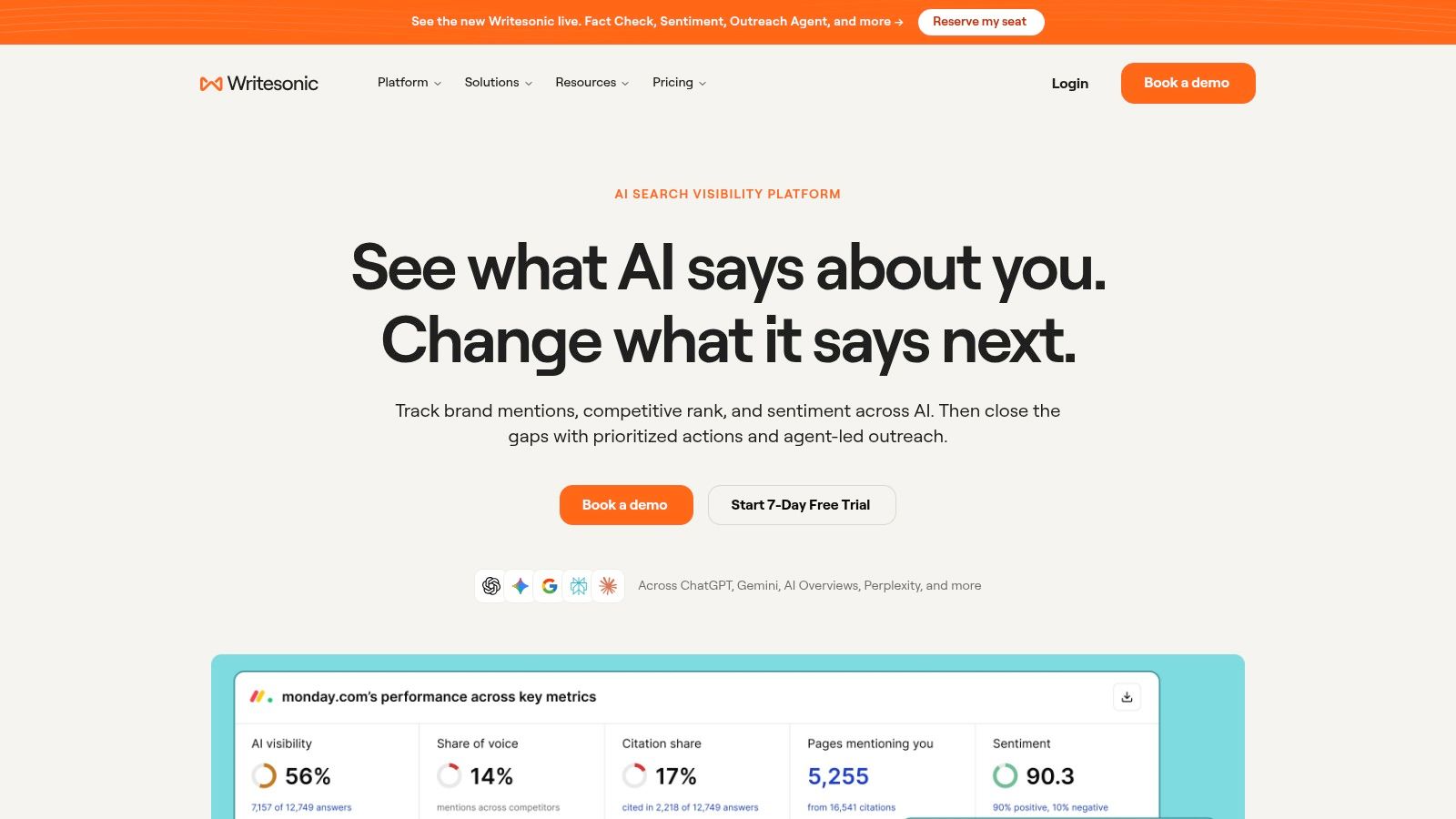
Brand and agency plans are published separately, with their own limits. GEO tracking availability depends on the plan, so the feature grid matters more than the product name. On applicable plans you get visibility tracking, site audits, and prompt tracking beside writing and optimization tools.
The failure mode is paying for a writing platform because you wanted a tracker. If editors already have a stack, the overlap is waste. If they do not, one workspace from gap to draft is faster than exporting a CSV into a blank doc. Coverage and prompt caps still vary, and a plan that looks complete in the nav can hide tracking on a higher tier.
New offers also need a name an assistant can repeat without colliding with three other products. A name comparison is a cheap check before you optimize pages around a label the model keeps mixing up. Confirm the plan table on Writesonic.
11. SE Visible
SE Visible is the SEO-suite path for teams already in SE Ranking, not a clean off-the-shelf price you can compare in one glance.
It watches brand presence in AI search alongside ordinary SEO performance, and that context is the main benefit. Your prompt tracking sits beside the keyword history and ranking data the account already holds, so you are not starting from a blank prompt list. The trade-off is that access and packaging can vary by account, and what one workspace sees may differ from what another team in the same company gets.
Public limits are harder to line up against Peec or Otterly. Before you treat it as the tracker, get engines, locations, and prompt volume confirmed in writing. I keep it when the team will not adopt a second SEO platform and the coverage matches the markets you sell in. I leave it when "which models, how often, how many prompts" stays vague, because a tracker without a fixed prompt set gives you no baseline to measure against.
Availability and pricing belong on SE Visible, checked the week you buy.
How the leading AI visibility tools compare on listed pricing, entry options, and best use
| Item | Listed starting price | Free entry option | Best for | Main limitation |
|---|---|---|---|---|
| Synup | Not stated | Not stated | Multi-location brands and agencies managing local marketing and AI visibility | Pricing depends on location count and agent throughput |
| Peec AI | Not stated | Not stated | Teams seeking focused AI-search analytics and competitor reporting | Lower plans limit prompts, models, and projects |
| Otterly.AI | $29/month | Not stated | Businesses starting AI visibility tracking with a focused prompt set | Coverage and prompt limits vary by plan |
| Semrush AI Visibility Toolkit | $99/month per domain, billed annually | Not stated | Teams combining AI visibility monitoring with SEO research | Base plan limits domains and custom prompts |
| Ahrefs Brand Radar | $199/month | Not stated | Ahrefs users researching brand presence and competitors | Custom prompt tracking is metered and may add cost |
| Profound | $99/month, billed yearly | Not stated | Teams combining AI visibility monitoring with content capabilities | Starter tracks ChatGPT only |
| Scrunch | $250/month | Seven-day trial | Mid-market and enterprise teams pairing visibility tracking with site audits | Core has limited prompt and model coverage |
| AthenaHQ | Starter: $295/month | Essential plan with 300 credits | Teams wanting tracking, recommendations, and analytics integrations | Free tier is limited; usage is credit-based |
| Rankscale | $99/month | Essentials option for limited use | Teams needing broad AI-engine coverage and configurable monitoring | Credit usage can be complex; higher-volume plans cost more |
| Writesonic GEO | Not stated; varies by plan | Not stated | Teams combining AI visibility tracking with content creation | Tracking coverage and limits vary by plan |
| SE Visible | Not stated | Not stated | SE Ranking users adding AI visibility to SEO work | Access and packaging may depend on account status |
Matching the Tool to Your Team's Next Decision
Start with the questions a buyer asks, in the markets you sell, in the language you sell in. Twenty stable prompts beat two hundred you rewrite every Monday. Tag each one as discovery, comparison, or purchase. Then name two competitors you are willing to lose to in public. If you cannot name them, the share-of-voice chart has nothing honest to show.
A 2025 survey cited by industry coverage found that only 51% of marketers actively tracked brand visibility in AI-search platforms, while 38% were still exploring tools. The rest did not track it. The minimum that closes that gap is not another score. Log prompt coverage, whether you were included, the citation URL, who else was named, whether the source supports the claim, the tone, and the change by platform. Pipe that to Google Analytics and Search Console so a spike in mentions is not mistaken for revenue.
Separate the business systems the same way. A benchmark summarized from Conductor data, reported by The Rank Masters, put AI-referral share at about 1.08% across 13,770 domains and 3.3 billion sessions from May through September 2025. Another cited benchmark in that write-up put first-session conversion at 73% for AI referrals versus 23% for Google organic visitors. Those samples and definitions are not your forecast. They are a reason to keep AI referrals out of a generic organic bucket and to watch landing page, engagement, and conversion by source. Low volume can still be the visit that asks for a demo.
What to demand from the trial
A 2025 academic study collected answers across verticals, languages, paraphrases, and systems including Google, ChatGPT, Claude, Perplexity, and Gemini. It argued for measures such as position-adjusted word count and impression scores instead of one universal rank, and it found AI search favoring third-party earned media over brand-owned and social content, unlike traditional search. So the “best” platform is the one that shows uncertainty. Was the mention accurate, favorable, and tied to a page you can improve, or was it a name drop with no citation?
Run one fixed prompt set for four to six weeks before you sign an annual plan. In week one, decide standalone tracker, suite add-on, content workflow, or site audit. Match engine list and credit or prompt caps to that set, including locations. Do not add prompts mid-trial or the trend is fake. At the end, keep the tool that repeats cleanly. Drop the one that only looked busy in the demo.
Pick the decision your team is facing this month, then trial one platform against the same prompt list for a month. If you are still shaping the brand those models need to recognize, start with a name, a logo, and a domain that match on Bilgu, then point the tracker at that identity instead of three conflicting versions.
Enjoyed this article?
Explore more guides and tools to supercharge your domain and brand building.